


For Al Shirawi Enterprises, uptime is not just a performance metric; it is a promise. As one of the UAE’s leading distributors of commercial vehicles and heavy equipment, the company’s aftersales operations have been meticulously engineered to maximise productivity for customers who depend on their machines every day.
“Minimising downtime and ensuring uptime are at the very core of our aftersales philosophy,” says Santhosh Varghese, Deputy Director – After Sales at Al Shirawi Enterprises.
“Our customers operate in sectors where even an hour of lost operation can have a significant financial impact. Whether it’s a construction fleet, a logistics operator, or an industrial customer, our goal is always the same: to keep their assets running reliably and efficiently.”
Al Shirawi’s aftersales division operates one of the most comprehensive service networks in the UAE. Strategically located service centres, a fleet of mobile workshops, and dedicated on-site service teams ensure coverage across key regions. “We’ve expanded our network so that customers can get rapid support no matter where their equipment is located,” Varghese explains.
“Our mobile service units function as fully equipped workshops on wheels. They’re stocked with tools, diagnostic devices, and essential spare parts, enabling our engineers to perform repairs and maintenance right at the customer’s site.”
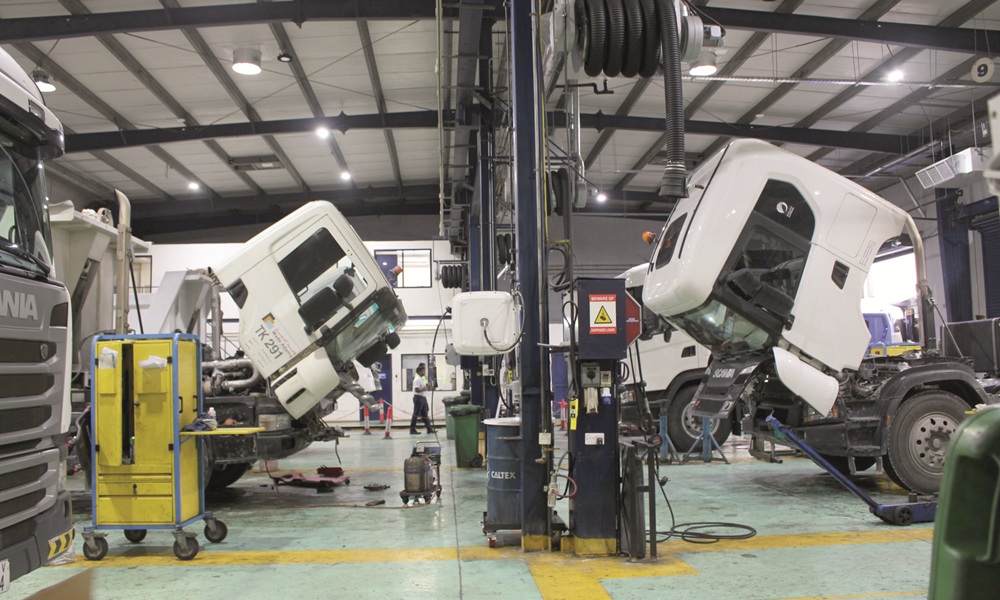
The company’s workshops are built around efficiency and speed. Standardised processes, digital job tracking, and lean workflows mean that turnaround times are tightly controlled.
“Every minute a vehicle or machine spends in our workshop, we’re conscious of the cost to the customer,” he says. “That’s why we focus on quick diagnosis, accurate repair, and proactive communication. Our first-time fix rate is one of the key metrics we track, and our teams are trained to get it right on the first visit.”
Proactive Maintenance for Predictable Operations
Al Shirawi’s maintenance philosophy goes beyond reacting to breakdowns. Its emphasis is on preventive and predictive maintenance, helping customers plan their service schedules and avoid costly downtime.
“We encourage customers to view maintenance not as an expense, but as an investment in uptime,” says Varghese. “Through maintenance contracts, we take responsibility for the entire service schedule, ensuring that every piece of equipment is maintained in line with manufacturer recommendations.”
Under these contracts, customers benefit from fixed service costs, scheduled inspections, and the use of genuine spare parts. “The result is not only reduced downtime but also improved asset life and higher resale value,” Varghese adds. “For larger fleet operators, we offer customised agreements that can include full-time technicians stationed at the customer’s premises. This model has proven to be very effective for logistics and construction clients who operate continuously.”
Predictive maintenance has become another strategic focus. “We’re using telematics and data analytics to monitor equipment performance and identify potential issues before they result in breakdowns,” Varghese explains. “For example, we can track parameters such as engine hours, temperatures, and error codes in real time. Our service team analyses this data to schedule maintenance proactively and alert customers when early intervention is needed.”
Delivering uptime depends on the expertise of Al Shirawi’s workforce. “You can have the best tools and technology, but it’s the people who make the difference,” Varghese says. The company invests heavily in continuous training for technicians, service advisors, and parts specialists. “We ensure that our teams are certified by the OEMs we represent, and we maintain an in-house training centre where new recruits and experienced staff alike can refine their skills,” he adds.
Technicians are supported by advanced diagnostic tools and mobile tablets that allow them to access repair histories, digital manuals, and real-time job updates. “This digitalisation of the workshop floor has transformed the way we operate,” Varghese notes. “It eliminates paperwork, reduces errors, and accelerates the flow of information between teams and customers. When a job is completed, our system updates the customer record instantly, ensuring transparency and accountability.”
A major component of uptime is the ability to supply spare parts quickly and accurately.
“We maintain a large inventory of fast-moving and critical parts to ensure immediate availability,” says Varghese. “Our collaboration with OEMs on joint forecasting and supply chain management allows us to minimise delays and respond rapidly to customer needs.”
To complement this, Al Shirawi’s spare parts logistics operation runs daily dispatches to service branches across the UAE, ensuring that even remote sites are supplied promptly.
“We’ve built redundancy into our supply chain,” Varghese explains. “If one route is delayed, another branch can fulfil the requirement. That flexibility allows us to maintain high levels of service even during periods of peak demand or disruption.”
Unplanned downtime caused by accidents can be particularly challenging for fleet operators. To address this, Al Shirawi operates one of the UAE’s most advanced bodyshops.
“Our facility is designed to handle complete structural, mechanical, and cosmetic repairs under one roof,” says Varghese. “We use the latest Josam chassis alignment systems and have a paint booth large enough for full-size buses and tankers. By combining these capabilities in one location, we can return vehicles to service faster.”
Al Shirawi’s insurance coordination team also works directly with insurers to streamline approvals and minimise paperwork for customers. “When a vehicle comes in after an accident, our team handles everything: assessment, estimation, insurance communication, and repair,” he adds. “It’s a complete end-to-end solution aimed at getting customers back on the road quickly.”
Uptime as a Partnership
For Varghese, driving uptime is as much about partnership as it is about process. “Our customers trust us to manage their assets as if they were our own,” he says. “That trust is built on consistency, transparency, and performance. Every service contract, every repair, every inspection is part of a bigger relationship that’s focused on keeping our customers operational.”
He adds that the company’s success in maintaining high uptime levels is also a reflection of its strong collaboration with OEMs. “The integration we have with our brand partners allows us to deliver faster diagnostics, quicker parts support, and more efficient warranty processing. It’s a system designed around the customer, not the company.”
Looking ahead, Varghese sees technology continuing to drive progress. “Telematics, AI-driven diagnostics, and digital fleet monitoring will play an even greater role,” he predicts.
“The future of uptime management will be about real-time insights and predictive actions.
At Al Shirawi, we’re already taking those steps today.”
With a comprehensive network, advanced systems, and a team dedicated to customer success, Al Shirawi’s aftersales division continues to set the standard for uptime and reliability in the UAE — ensuring that fleets, machines, and operators remain productive, safe, and ready for the road ahead.

