


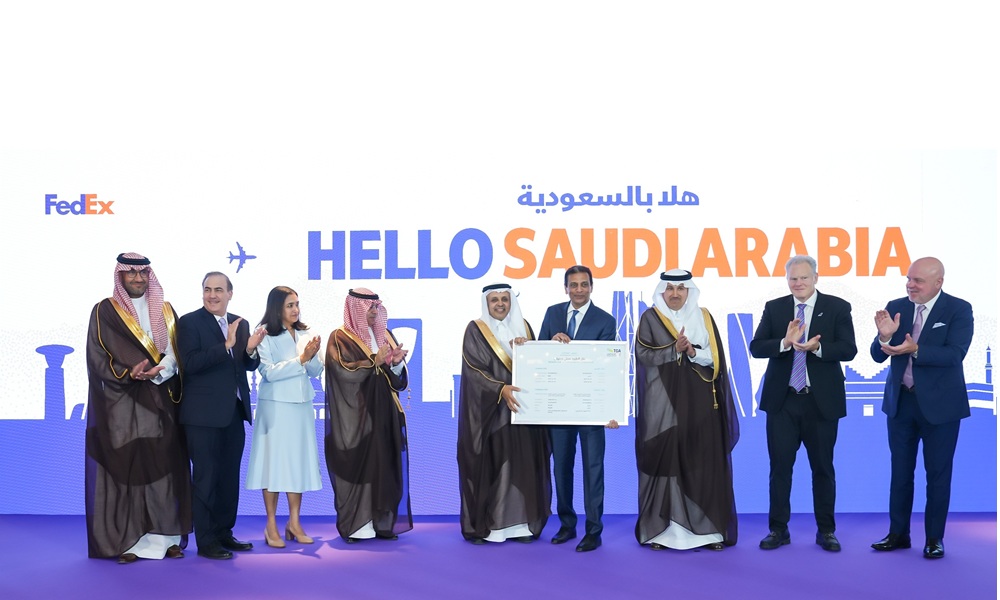
Federal Express Corporation (FedEx)has announced the completion of its transition to a direct-serve presence in Saudi Arabia with the launch of the first dedicated FedEx flight into Saudi Arabia, the development of a regional hub at the upcoming King Salman International Airport, and the expansion of FedEx Logistics freight forwarding services into the Kingdom.
These initiatives are expected to boost operational capacity, create employment opportunities, and align closely with Saudi Arabia’s Vision 2030 goals of economic diversification and global trade integration, said the firm.
The milestone was marked during a ceremony in Diriyah, attended by H.E. Eng. Saleh bin Nasser Al-Jasser, Minister of Transport and Logistics Services and Chairman of the Transport General Authority; H.E. Dr. Rumaih bin Mohammed Al-Rumaih, Vice Minister of Transport and Logistics Services and Acting President of the Transport General Authority; and senior FedEx executives including Raj Subramaniam, president and CEO of FedEx Corporation; Richard Smith, COO, International and CEO, Airline, FedEx; and Kami Viswanathan, president of FedEx Middle East, Indian Subcontinent and Africa.
“FedEx’s strengthened presence reflects the Kingdom’s growing appeal as a premier destination for logistics and global investment,” said H.E. Eng. Al-Jasser. “The increasing number of leading global logistics and courier companies establishing direct operations in the Kingdom demonstrates the strength of Saudi Arabia’s logistics sector and its pro-investment environment, as well as the global confidence in the Kingdom’s transformation journey.”
Richard Smith added: “Our recent investments underscore Saudi Arabia’s role as a vital link in our global network. By expanding in the Kingdom, we are broadening our network’s reach and creating faster, more dependable trade routes that connect Asia, Europe, and the Americas.”
Kami Viswanathan emphasised the strategic value of the expansion: “Our direct-serve operations in Saudi Arabia represent a pivotal step in our regional growth strategy. By combining modern infrastructure, digital innovation, and integrated solutions, we are facilitating seamless trade and helping businesses in Saudi Arabia and across the region compete globally. This reflects our commitment to supporting Saudi Vision 2030 and cementing the Kingdom’s position as a logistics powerhouse.”
FedEx’s new direct-serve model gives customers end-to-end control of pickup, delivery, and customs clearance, supported by local infrastructure comprising four gateways and four stations. These are complemented by digital shipping tools to improve visibility and efficiency across supply chains.
The company has also introduced the first dedicated FedEx flight into Saudi Arabia, providing the only nonstop air connection from the United States and Europe to the Kingdom, strengthening transit times and trade flows. A new regional hub in Riyadh will serve as a strategic link connecting Saudi Arabia, Bahrain, Kuwait, and Qatar.
Additionally, FedEx Logistics has launched freight forwarding services covering air, road, and ocean freight, along with customs brokerage and transit cargo support. These services are designed to strengthen supply chain resilience and connectivity with key markets in the GCC, South Asia, and Africa.
Saudi Arabia’s economic performance further highlights the importance of logistics investment. In Q1 2025, the Kingdom recorded a trade surplus of US$16.8 billion (SAR 63 billion), a 52% increase compared to Q4 2024, underlining the growing demand for advanced logistics infrastructure.
With its new infrastructure, technology investments, and workforce development initiatives, FedEx is positioning itself as a long-term partner in Saudi Arabia’s transformation into a global logistics hub.

