


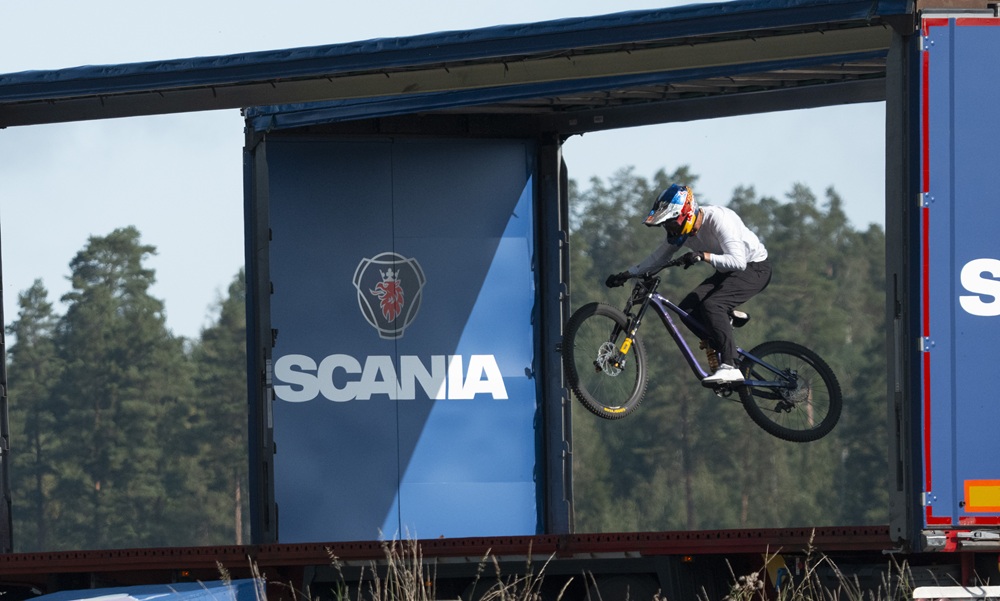
Scania isn’t jumping through hoops to prove the maturity and reliability of its autonomous transport technology, it’s jumping through truck trailers with Red Bull.
In a high-speed stunt involving two self-driving trucks, a split-second manoeuvre, and Red Bull athlete Matt Jones—completed with no humans in either vehicle and zero margin for error.
The Swedish manufacturer says the feat highlights the precision, awareness and consistency of its emerging autonomous solutions, which are now being piloted in mines and on public roads and are expected to reach full commercialisation within the next few years.

Scania / Red Bull feature with Mountain biker Matt Jones
Day 3
“Impossible” stunt proves precision of Scania’s autonomous systems
Scania’s engineering team set out to demonstrate exactly how stable and predictable its autonomous control stack has become. Working with partners PlusAI and Red Bull, the company programmed two autonomous Scania trucks to drive towards each other in opposite directions at speed, with centimetre accuracy. A less-than-one-second window was created as the two vehicles passed—a gap so narrow that even slight deviation would have ended the attempt.
Professional mountain biker and Red Bull athlete Matt Jones then rode his bike into this gap at the exact moment the trucks crossed paths, passing cleanly through the moving corridor.
Scania says the outcome was never in doubt.
“Thanks to our super-intelligent, precise and safe autonomous solutions, we were able to create this ‘golden gap’,” the company explained. “Our teams, together with Red Bull and Matt Jones, worked for months—crunching data, simulating and testing over and over again. When it was showtime, we were ready.”
Peter Hafmar, Vice President and Head of Autonomous Solutions at Scania, called the challenge a glimpse of what next-generation on-road autonomy will deliver. “This challenge was a glimpse of what’s possible when breakthrough autonomous technology delivers precision and safety you can count on,” he said.
Autonomous transport “already here today”
Hafmar insists the industry still underestimates how close autonomous, driverless operations really are.
“A lot of people say that autonomous solutions on the road are far away. They’re not. It’s already here today,” he said. “We are operating pilot operations in Europe with safety drivers, of course—but in a few years, that safety driver will be removed.”
With a global shortage of nearly three million truck drivers, Hafmar argues that autonomy is no longer optional. “To be able to solve that problem, we need to add in more drivers,” he said. “And that driver is spelled autonomous.”
Scania’s current autonomous vehicles are already supporting mining customers in select regions, improving safety and reducing operational emissions. In parallel, European hub-to-hub trials with safety drivers are progressing, laying the groundwork for fully driverless freight corridors.
“Autonomous trucks are programmed to maintain safe speeds, safe distances and safe lane positions,” Hafmar said. “They reduce the risk of accidents, operate continuously, and optimise energy consumption—especially when paired with hybrid or fully electric drivelines.”
Scania says autonomous development has accelerated its transformation into an advanced software-driven organisation. The autonomous driving software stack—developed in partnership with TRATON and specialist technology companies such as PlusAI—is described as “among the most sophisticated in the world.”
“Scania and TRATON have transformed the transport industry for years,” Hafmar said. “We now have the most brilliant engineers, and we’re heading for the future.”
For fleet operators in the Middle East, Scania’s work signals a rapid shift in global logistics that could reach regional long-haul corridors, distribution hubs and industrial zones sooner than expected. With rising demand, tightening sustainability targets and persistent labour shortages, the case for autonomy continues to grow.
“Transport is a cornerstone of our daily lives,” Hafmar said. “With autonomous solutions, we will ensure that we can continue to transport goods in the safest and most efficient way.”
The Red Bull stunt, Scania says, is not just a marketing moment—it is a real-world snapshot of the precision, predictability and safety that future driverless logistics networks will rely on.

