



From the world’s first motorised van to the intelligent, connected Sprinter of tomorrow, Mercedes-Benz invited T&FME to Germany last week to prove that its past and future share the same DNA: cutting-edge tech driven by customer need.
In Stuttgart, Mercedes-Benz Vans opened the doors to its history and its future. From the gleaming Mercedes-Benz Museum, to the leafy test routes around Neuhausen and then onto the scent of aged leather and engine oil in Waiblingen’s living workshop, the visit traced a journey that spans 130 years of invention, and a future defined by intelligence, sustainability and customer-first design.
“For me personally, 1896 is a very important year,” began Marcel Minter, Director of Development Strategy and Sustainability at Mercedes-Benz Vans. “Karl Benz laid the foundation that allows me to stand here today. Back in those days, Benz invented the first two motorised transporters; and commercial vans are still the core of our business today.”
That year, Benz delivered the world’s first motorised delivery van to the Parisian department store Du Bon Marché; the vehicle that effectively created the light commercial vehicle segment. It carried 300 kilograms of goods, travelled at 15 km/h and was powered by a one-cylinder, four-stroke engine. “With this vehicle,” Minter said, “we were not only faster than the horse-drawn carts of the time; we could carry three times more cargo. From day one, Mercedes-Benz vans were about efficiency and customer value.”
Standing beside an exact replica of that 1899 Ideal Van, painstakingly rebuilt by the Mercedes-Benz Classic team, Minter’s pride was unmistakable. But the van is not just a museum piece; it’s where everything Mercedes-Benz Vans stands for began.
“It’s the oldest roadworthy delivery van in the world,” he said, smiling.

A short drive away in Waiblingen, the Mercedes-Benz workshop and archive houses dozens of restored vans, all kept operational and still driven. “Every car runs,” our guide explained during a tour of its austere factory hallways and workshops. Standing beside a gleaming blue O319 from 1963, he adde: “We drive each vehicle about 30 to 40 kilometres every six months to keep the engines healthy. We charge the batteries permanently. This is not a static museum; this is living history.”
The rows of vintage vans are more than nostalgia pieces. They chart a century of commercial evolution, from the post-war Düsseldorfer Transporter and the T1 “Bremer” model to the box-bodied Vario and the early camper vans that became the Marco Polo and James Cook legends.
“Each car has its story,” the guide added, showing us a bright red T1 James Cook that still smelled faintly of varnish and camping gas. “When we bought this one in Hamburg, it had nearly 300,000 kilometres on it. The interior is original; we didn’t touch it. When you look inside, it’s not old. There’s a bed in the roof, a table you can rotate, a bathroom. It’s timeless.”
Even the vehicles’ quirks are preserved with care. The early O319 omnibus, with its wooden steering wheel and sofa-like bench seats, requires brute strength to manoeuvre. “You get such arms,” he laughed, gesturing to the wheel. “It only has 65 horsepower; it’s no race car, but when you drive it, you feel where everything began.”
From the Sprinter to the Superbrain
Mercedes-Benz’s modern story is equally bound to the Sprinter, now celebrating its 30th anniversary. Launched in 1995, it was the first van to combine serious cargo capacity with car-like handling and safety. It set new standards for driver comfort, braking and crash protection, and has since sold more than five million units worldwide.
“Exactly 30 years ago, we listened very carefully to our customers and we found out that they’re asking for more cargo space. And it is why we, for the first time, combined cargo space with passenger car-like driving abilities. Even 30 years ago, the Sprinter was based on the principle that makes many startups very successful today.
“The Sprinter is a vehicle for almost every life situation,” said Minter. “It’s there when companies are founded and where lives are saved; where parcels or frozen goods are delivered; where houses are built and holidays begin. It’s part of everyday life, and that’s what makes it so special. The Sprinter is used to build houses, to renovate bathrooms, to plant trees and to experience travel adventures and of course to sell ice cream.”
He added: “When we talk about customer loyalty, one number stands out; seventy-seven per cent of Sprinter customers buy another Sprinter. That’s extraordinary in any industry. It shows the trust we’ve earned and the responsibility we have to keep improving.”
Minter described the Sprinter as “robust, reliable, versatile and durable; qualities that will remain the pillars of every future generation.”
View this post on Instagram
Enter MB.OS: The Digital Operating System for Mobility
That focus on uptime and intelligence is now being redefined through MB.OS, the Mercedes-Benz Operating System. Introduced by Carlos Zafrane, Head of Product Management for Vans, it represents the digital core of the company’s next-generation architecture.
“MB.OS turns every Mercedes-Benz into a digital asset; a smartphone on wheels that keeps learning, improving and holding its value for years,” Zafrane explained. “It integrates infotainment, connectivity, safety and energy management into one super-brain.”
The platform has three layers: powerful onboard computers that replace dozens of control units; a high-speed digital network connecting every sensor and actuator; and the Mercedes Intelligent Cloud, linked via 5G. Together they allow software updates, driver-assist calibration and even new features to be installed over the air.
“Customers can buy additional functions after delivery,” said Zafrane. “If you forget to configure something, you can add it later. The van will stay current throughout its life, just like a phone.”
For fleet owners, that means predictive maintenance and fewer surprises. “The sensors know the health of the battery, the terrain, the charging network,” he added. “They can predict when a component is about to fail. The workshop knows before the customer arrives what to do; downtime becomes planned time.”
Security and data privacy remain paramount. “We apply the strict European privacy rules worldwide,” Zafrane stressed. “Personal data will never be shared without consent.”
For Minter, the digital transition is not about gadgets; it’s about longevity. “In the past, vehicles changed when you bought a new one. Now customers expect vehicles to evolve like smartphones. That’s why MB.OS is so critical; it keeps the van fresh and valuable for years.”
He described the approach as “the perfect link between mechanical engineering and digital innovation.” The new system, he said, would ensure that “our vans are not only reliable work tools but digital partners for our customers’ businesses.”
Perhaps the most transformative part of MB.OS is its openness. “Our commercial customers can build in their own software and tools,” Minter said. “They can use them directly in the head unit with the same look and feel as Mercedes-Benz apps. This is how we redefine digital in the commercial segment.”
Zafrane confirmed that the system will first appear on the upcoming Van Electric Architecture (VAN.EA) platform in 2026. “Every new commercial van will run on MB.OS,” he said. “It’s our foundation for electric and connected vehicles; built by Mercedes-Benz, for Mercedes-Benz.”
At Stuttgart, Minter unveiled a clay sculpture representing the design direction of the next Sprinter. “It’s unfinished on purpose,” he explained. “It symbolises that we are still shaping the future. Development is not complete, but the vision is clear.”
He described the next-generation commercial van as “boxier, more robust and more intelligent.” “The design gives our customers much more flexibility,” he said. “We will offer multiple lengths, wheelbases and drive variants, from parcel delivery to camper vans. Our ambition is to offer the world’s most desirable vans.”
The eSprinter and Electric Ambition
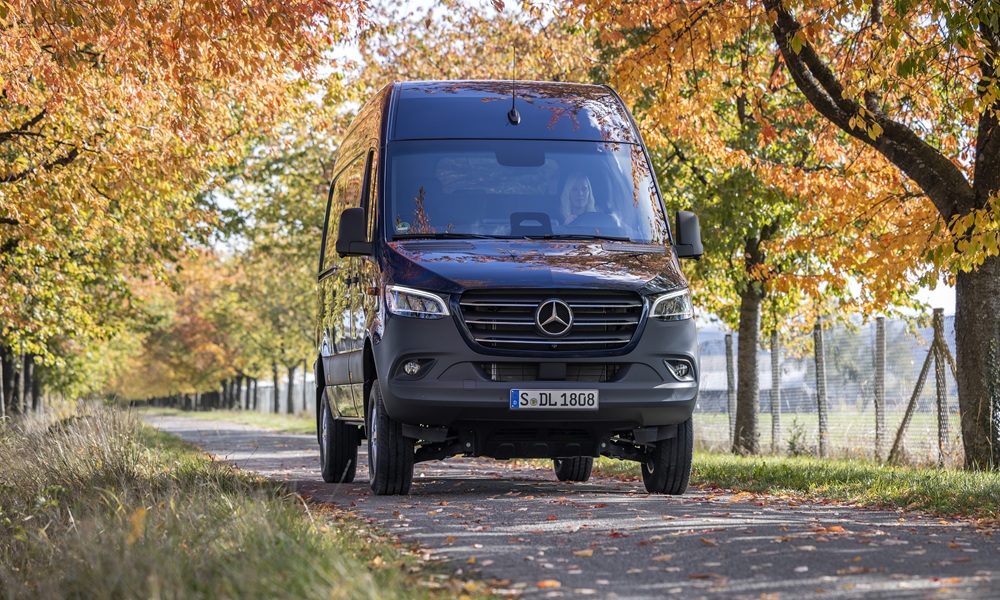
Mercedes-Benz’s eSprinter, already in its latest generation, offers up to 484 kilometres of range (WLTP) and demonstrates how far the brand’s electrification strategy has advanced. For Middle East operators, where range, payload and temperature management are daily considerations, the eSprinter’s modular battery options and predictive route planning are designed to make electrification practical.
Zafrane explained: “With MB.OS, the vehicle knows the battery’s health, state of charge and terrain. It plans the best route and pre-conditions the battery for faster charging. We want to make electric driving easy, not intimidating.”
Minter framed the eSprinter’s success in broader terms. “Sustainability and profitability must go hand in hand,” he said. “Electric vans must earn money for our customers; only then will they become mainstream. That’s what we are building towards.”
While the vision is clear, the path to adoption in the Middle East is complex. The UAE and Saudi Arabia have made significant strides in establishing electric charging corridors, but infrastructure remains uneven once fleets venture beyond the main urban centres. For large logistics or rental operators, the question is no longer whether electric vans work; it is whether they can be operated efficiently in regions where charging stations are still scarce and power tariffs vary widely.
Connected-vehicle technology faces its own hurdles. Data-sharing and over-the-air functionality can be limited by local regulatory restrictions, particularly around mapping data and cloud connectivity. Speaking to the Mercedes-Benz Vans team, it is clear that there is some frustration that some regions will take longer to unlock the full potential of MB.OS. But the system is design to scale globally and adapt locally, and it likely that it will continue to we work closely with its regional partners to ensure compliance and customer benefit can be delivered at the same time.
In markets like the UAE, where heat management and long operating hours put unique pressure on battery systems, the eSprinter’s modular battery strategy may prove a differentiator. The technology can be calibrated for local conditions with thermal management, energy recovery and service intervals are all configurable.
Fleet electrification will likely advance first among logistics operators, last-mile couriers and urban delivery fleets, where routes are predictable and charging can be centralised. For regional distribution and cross-border operations, diesel-powered Sprinters are likely to remain the backbone of operations for years to come.
Back in Waiblingen, among the steel and paint of half a century of transporters, it was clear that Mercedes-Benz’s future is not a break from its past but a continuation of the same idea. The company that once built delivery vans under candlelight in Mannheim now builds digital ecosystems powered by cloud intelligence. But the purpose remains unchanged: to serve the people who keep cities, industries and supply chains moving.
“We are the inventors of the light commercial vehicle,” Minter reminded us. “And we’re constantly innovating the whole segment. Our focus has always been the customer, and it always will be.”
Mercedes-Benz Vans is entering its most ambitious decade yet, one where AI, electrification and design converge to deliver uptime, insight and sustainability. The next Sprinter will not only carry goods and people; it will carry the accumulated intelligence of a century of engineering.
Or, as Minter put it in his closing words: “We want our vans to go the extra mile; because our customers do the same every day.”
2026: 130 Years of Vans
- 1896 — Karl Benz builds the first motorised delivery van
- 1955 — O319 omnibus introduces sliding doors and modular bodies
- 1977 — T1 “Bremer” sets new standards for usability and comfort
- 1995 — First Sprinter revolutionises safety and drivability
- 2019 — eSprinter debuts, bringing zero-emission logistics

