


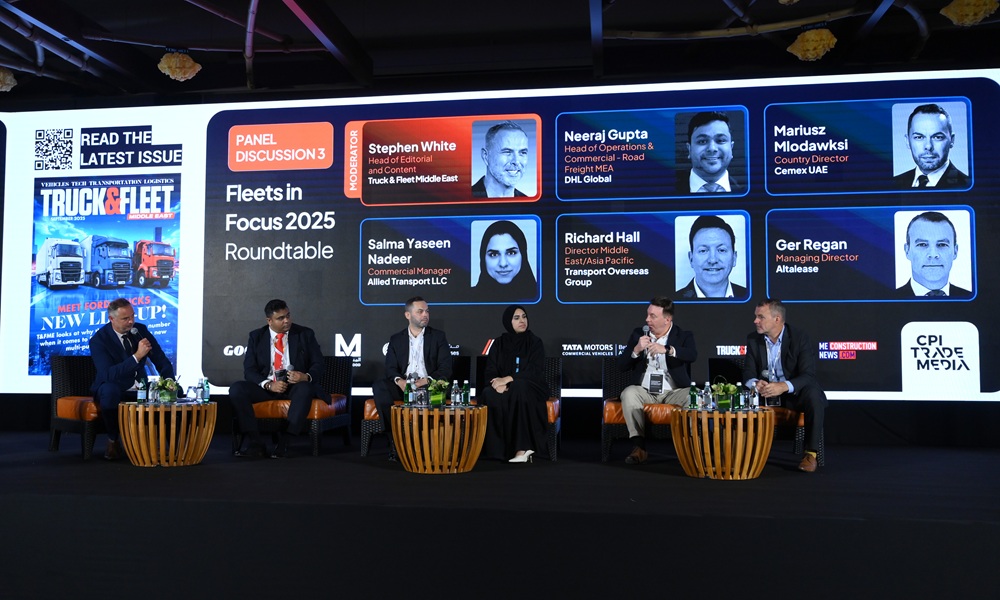
At the Truck and Fleet Confex, fleet leaders from Cemex, DHL, and Allied Transport joined shipping and financing experts to debate the future of road freight in the GCC. From sustainability and regulation to financing and driver retention, the discussion highlighted both the opportunities and the hurdles facing operators.
The Fleets in Focus panel at the Truck and Fleet Confex brought together some of the most influential names in regional logistics and transport. Neeraj Gupta, Head of Operations & Commercial – Road Freight MEA at DHL Global, Mariusz Mlodawski, Country Director at Cemex UAE, and Salma Yaseen Nadeer, Commercial Manager at Allied Transport LLC shared the stage with Richard Hall, Director Middle East/Asia Pacific at Transport Overseas Group, and Ger Regan, Managing Director at Altalease. Together, they explored the pressing challenges confronting fleets in the GCC, from surging demand and supply chain disruption to financing models and the shift to sustainable transport.
Gupta set the tone by describing a sector under immense pressure to expand. He explained that DHL manages operations across 28 countries in the Middle East and Africa and has not seen a more dynamic moment than today.
Demand for trucks is increasing at pace, alongside rising expectations on safety, quality and service. “The market is quite dynamic, quite exciting,” he said. “You need to find the right solution for the customer because customers are getting very sensitive from that solution perspective.”
Mlodawski confirmed that the situation is the same for Cemex, with rapid growth creating new pressures. “We all remember the COVID time and the lockdown. It was a very interesting time for all of us. Now we see that the market growth is so rapid that it is a big challenge to find the right partners to manage the business in the best and optimised way,” he said.
For Allied Transport, customer expectations have shifted dramatically since the pandemic. Nadeer explained that clients no longer want to engage with multiple service providers; instead, they expect comprehensive solutions from a single partner.
“What we have been seeing post-COVID is the customer retention who want to stick to the solution and the providers who also have in-house capabilities,” she said.
“Customers don’t want to go through multiple doors or different services. That puts us in a very good place to have those long-term relationships with our customers.”
Meeting demand increasingly means demonstrating not just logistical strength, but also sustainability and long-term commitment.
“Customers want to know that their provider is a long-term player, with the ability to deliver everything from within one roof — and that includes delivering on sustainability,” she added.
Shipping remains a crucial constraint. Hall outlined the difficulties operators still face in getting vehicles into the region. “As a shipping company, we see all brands, all volumes. This year is very strong, whether it’s coming from the east or the west. But certain routes are still heavily overloaded or overbooked. And from the West, you’re still taking the longer route around South Africa because the traditional route through the Suez is just not possible right now,” he explained. While conditions have improved somewhat, rerouted shipments and congested ports continue to affect planning and pricing
Regan brought a financing perspective, noting that fleet operators are under growing pressure to adopt flexible models. “Operating leases, finance leases are the products of choice that will drive this industry in the next five to ten years,” he said. He pointed out that distributors are increasingly required to decide whether to offload financing or extend credit to end users themselves. Regulatory bottlenecks also hinder progress.
“As a company, Altalease applied for the first finance leasing licence two years ago. Now, two years later, we’re still waiting for some of the bureaucracy to alleviate itself,” he added.
New Energy Vehicles (NEVs) were a central talking point. Cemex has already trialled electric trucks in its operations, including the first electric concrete truck in the Middle East. “We wanted to re-operate this truck, not bring it and put it as a display,” Mlodawski said.
“Obviously, there are challenges for heavy industry, but we need to move to more sustainable solutions.” DHL is pursuing both electric and hydrogen projects, with Gupta revealing that the company is testing hydrogen trucks in Saudi Arabia in partnership with Aramco.
“We started with heavy electric trucks, and our next goal is to move into small boxes and vans,” he said. “In parallel, we are also doing a trial for the first hydrogen truck in Saudi with Aramco.” Allied Transport is also embracing hydrogen. “Hydrogen trucks are the way forward,” argued Nadeer. “Why? Because you’re completely handling the resources, without the issue of battery disposal. We are definitely going hand in hand with the community’s vision on sustainability and carbon emission reduction.” Yet, as Hall pointed out, despite these pilots, “99.9% of what we bring to this region is still traditional combustion engine vehicles,” a stark reminder of the dominance of diesel.
The panel also agreed that customers are now a driving force in shaping fleet investment. Gupta stressed that until buyers stop focusing exclusively on price, the adoption of greener solutions will remain slow. “The real pivot will only come when regulation becomes very strong across the GCC — when emission norms, biofuel quotas or sustainable cargo mandates are enforced,” he said.
Mlodawski added that Cemex is determined to take the lead. “If we declare ourselves sustainable, then not only our products, but also the way we operate on a daily basis needs to be more sustainable,” he said.
Nadeer reminded the audience that drivers remain at the heart of fleet performance. “It’s completely about the drivers, because we are relying on them. They deal with the customers first-hand, so they are our confidants,” she said. Allied invests significantly in driver welfare, ensuring stable accommodation and secure working environments. This, she argued, is fundamental to delivering both safe operations and strong customer service.
Looking ahead, digitalisation and artificial intelligence will play a larger role in fleet efficiency. Gupta explained that DHL is already deploying AI to optimise capacity. “We are focusing on real-time tracking, using AI to generate more cargo efficiency per truck, reducing empty returns. We are pivoting to AI so that we are not depending on an experienced individual to take a decision, but the system itself can tell,” he said.
Mlodawski agreed that AI is the “common opportunity for all of us,” while Nadeer urged customers to understand “the bigger goal” and support sustainable initiatives.
The Fleets in Focus panel showed a market defined by both opportunity and challenge. Demand in the GCC is at unprecedented levels, but operators must balance that growth with financing pressures, import bottlenecks, and the high costs of adopting new energy solutions. Customers are setting the tone — pushing for long-term partners who can deliver integrated, greener logistics. And while diesel remains dominant, the increasing presence of NEVs signals a clear direction of travel.
As Hall put it, “It’s never been more competitive. But it’s never been more interesting, either.”

