


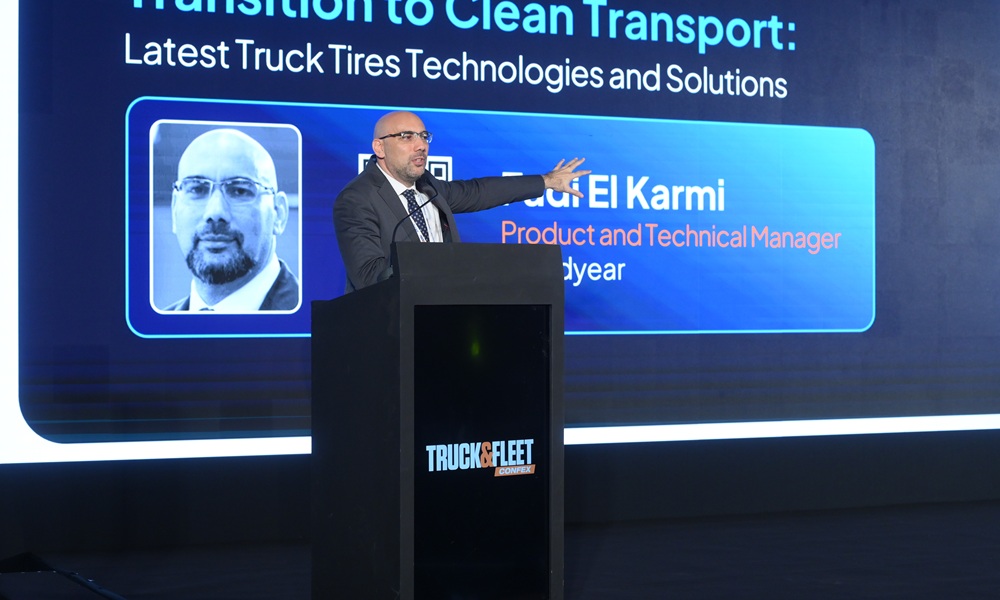
In his presentation at the Truck and Fleet Confex, Fadi El Karmi, Product and Technical Manager at Goodyear, reminded the audience that tyres are far more than rubber on the road — they are critical enablers of safety, efficiency and sustainability. “Tyres are really very important,” he said.
“The performance of those tyres highly depends on what we call tread compound. The technology on the rubber compounds themselves is becoming too advanced, with high silica compounds and complex polymers. Tyres today must do everything: brake, drive, give you mileage, withstand chipping and chunking, and deliver low rolling resistance for the future.”
El Karmi noted that Goodyear has reached a new milestone with the introduction of full silica compounds, offering superior performance, particularly for electric trucks. He also stressed that sustainability is no longer a future aspiration but a present reality. “We have just released something called Eco-Label,” he explained. “Today, we are actually commercialising products that are more than 40% made from sustainable material. A big part of that comes from rice husk ash, which is used to extract silica. This is already existing now, not just a future concept, and we are achieving sustainability without increasing costs or compromising performance.”
Electrification is reshaping tyre requirements, especially in the GCC where electric buses and light trucks are already on the roads. “We are making sure that every tyre that comes out is EV-ready,” El Karmi said. “The most important factor is load. Batteries are heavy, and manufacturers place them in different layouts — sometimes distributed across the truck, sometimes concentrated in the front. Tyres must be strong enough to carry the extra load and deliver low rolling resistance to maximise battery efficiency.”
Connectivity formed another central theme of El Karmi’s address. He detailed Goodyear’s use of RFID chips embedded in sidewalls to provide each tyre with a unique identifier, enabling easier integration with tyre management systems. He also pointed to the development of pressure and temperature sensors. “RFID is already commercialised in many of our products, while embedded pressure sensors are the next step. These systems will talk to other electronics and integrate into full tyre management solutions.”
The Goodyear product portfolio now includes a suite of digital solutions that bring tyre monitoring and management into the connected fleet ecosystem. El Karmi demonstrated innovations such as Tire Optics, a mobile app-based inspection tool; DrivePoint, a gate-based system that automatically reads tyre pressures as trucks pass through; and CheckPoint, a laser-equipped station that measures tread life, load and tyre pressure in seconds. These systems are supported by Goodyear’s TPMS, offering predictive algorithms that can forecast pressure loss before it causes a breakdown, all visualised through the FleetHub platform, which allows fleet managers to see the real-time status of every tyre across their operation
Perhaps the most striking development is TAS (Tyre as a Service), a system recently launched in Europe that automatically reinflates tyres when deflation occurs, removing the need for manual intervention. “Not only do you have live data for all your tyres, but you can immediately address any issue with pressure without having a technician on hand,” said El Karmi.
Customisation was also underscored as key to Goodyear’s GCC strategy. El Karmi pointed to ranges developed specifically for the region, such as heat-resistant tyres for long-haul transport in the UAE and 24-inch options designed for severe mixed-service conditions. “Customisation is very important in order to match the exact market requirements of UAE and GCC fleets,” he emphasised
Closing his presentation, El Karmi underlined that the innovations Goodyear is bringing to market are not about adding cost but about reducing total cost of ownership. “The future of mobility is not something that we are going to wait for. It’s already here. Now it’s time for fleets to implement, digitalise, and adopt the right solutions that fit their needs,” he concluded

