


The Middle East’s mining and quarrying sector is entering a new phase of growth. While the region has long been associated with oil & gas, governments are increasingly investing in the development of mineral resources as part of wider economic diversification strategies. Major infrastructure projects, urban expansion and industrial development are driving sustained demand for aggregates, limestone, gabbro and other construction materials, while ambitious national programmes, particularly in Saudi Arabia, are encouraging investment in the exploration and extraction of valuable minerals.
As production increases, so too does the need for efficient transport solutions capable of moving large volumes of material safely and economically. Fleet operators today are looking beyond outright purchase price, placing greater emphasis on productivity, fuel consumption, uptime, driver wellbeing and total cost of ownership. Manufacturers, in turn, are responding with vehicles that deliver more than simply high payloads, instead offering complete transport solutions tailored to the specific demands of heavy-duty applications.
It is against this backdrop that Scania is strengthening its focus on the mining and quarrying sector across the Middle East. Leading this effort is Luciano Piccirillo, who recently assumed the role of Sales Director for Scania Middle East after nearly two decades with the Swedish truck manufacturer.
Originally from Brazil, Piccirillo joined Scania in 2006 and has spent almost 20 years with the company in a variety of commercial roles. His extensive experience within the business provides him with a strong understanding of Scania’s engineering philosophy and its approach to delivering customer specific transport solutions.
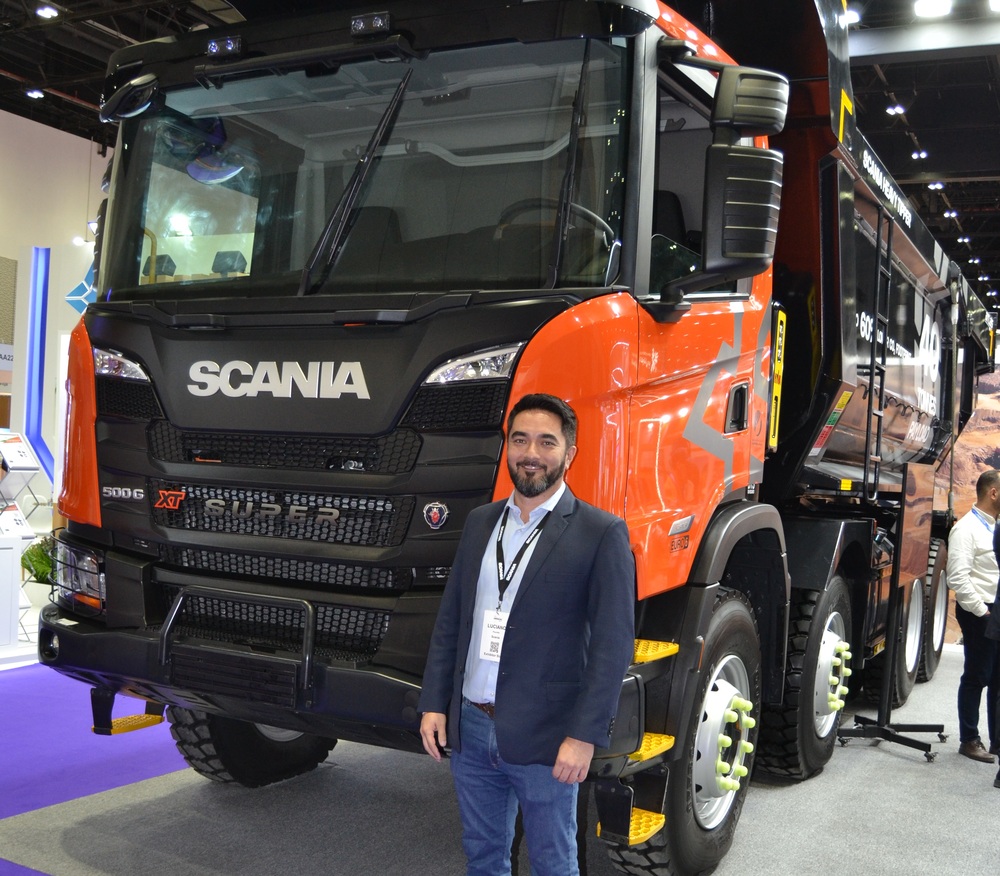
“The mining sector is a very important sector in the Middle East and it is increasing in importance across the region,” he explains. “This is particularly true in countries such as Saudi Arabia, the UAE and Oman.”
Rather than offering a single standard specification, Scania approaches the market through its well-established modular vehicle architecture, allowing trucks to be configured according to individual customer requirements.
“We have the possibility through our modular system to configure and customise our trucks to meet any demand that customers and operators have,” says Piccirillo. “Mining and quarrying is therefore a very important segment for us in this region.”
This flexibility has become one of Scania’s defining characteristics globally. By combining different chassis layouts, powertrain options, cabs and axle configurations from a common component platform, the company is able to build vehicles suited to a wide variety of applications while maintaining parts commonality and simplifying maintenance throughout the vehicle’s operating life.
Scania’s mining offering
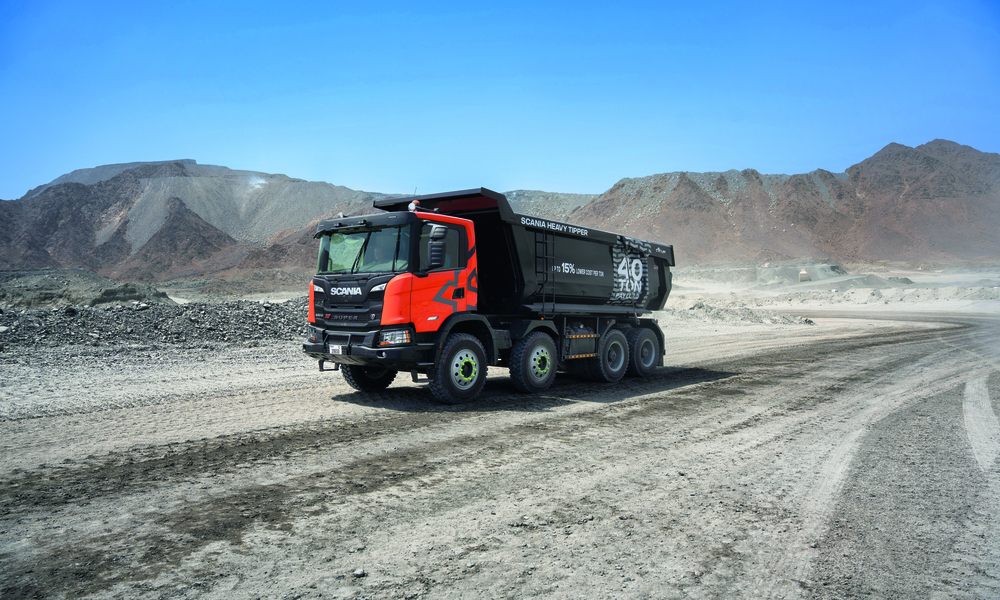
For mining and quarry operations in the Middle East, the company’s principal offering is its 8×4 Super tipper. According to Piccirillo, the vehicle has been developed to maximise payload while delivering the efficiency expected from an on road truck.
“The main product that we are bullish about is our 8×4 tipper, which has a gross vehicle weight of 60 tonnes while offering a payload of around 40 tonnes,” he says.
While conventional thinking often places rigid dump trucks and articulated haulers at the centre of quarry operations, Piccirillo believes there is significant scope for road-based tippers to undertake work traditionally handled by what the industry commonly refers to as “yellow machines”.
“Our truck competes with some of the smaller rigid and articulated haulers and even some larger models,” he explains. “Sometimes customers prefer to have two or three of our 8×4 tippers instead of one large hauler or dumper.”
The reasoning extends beyond simple payload calculations. Because the Scania trucks can travel at higher average speeds over suitable haul roads, cycle times can be reduced significantly. This allows operators to complete more loading and unloading cycles during a working shift, potentially moving more material overall despite each individual truck carrying a smaller payload than a dedicated mining dumper.
“We can decrease the cycle time because of the speed of the trucks,” says Piccirillo. “This enables customers to produce much more using our vehicles.”
Driver comfort also plays an important role in maintaining productivity throughout long operating shifts. “Our trucks offer very good comfort for drivers, which means less fatigue and more trips during the day.”
This emphasis on ergonomics reflects a broader trend across the commercial vehicle industry. Comfortable seating, improved visibility, lower noise levels and easier vehicle controls are increasingly recognised as factors that contribute not only to driver wellbeing but also to safety, retention and operational efficiency, particularly as skilled driver shortages continue to affect many transport markets around the world.
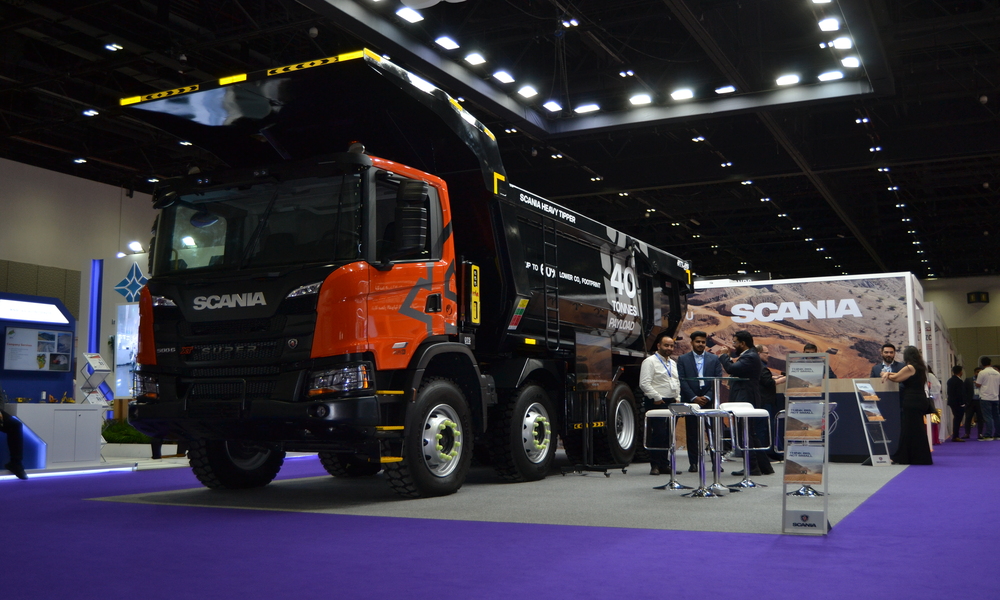
Lowering TCO
While productivity remains a major purchasing criterion, fleet owners are increasingly evaluating vehicles through the lens of total cost of ownership. Piccirillo believes this is an area where Scania’s solution demonstrates clear advantages.
“The comparison depends on the application and on which machine you are looking at,” he says. “Mining equipment ranges from around 40 tonnes to well over 150 tonnes of payload, so every operation is different.”
However, he argues that customers often discover meaningful savings when considering the complete operating picture rather than the purchase price alone.
“Normally, we have a much better price, not only for the truck itself but also when considering the total cost of operation, including maintenance, fuel costs and everything else.”
Fuel efficiency has become one of the defining performance measures for modern heavy trucks, particularly as diesel prices and environmental considerations continue to influence purchasing decisions.
Central to Scania’s latest offering is the company’s Super powertrain, introduced globally to improve drivetrain efficiency through a combination of engine, gearbox and axle developments.
Describes the Super platform as a significant step forward, Piccirillo says: “This model is part of our Super platform, which is our new powertrain that provides much better fuel consumption.”
The featured mining tipper is powered by a 500hp engine, combining high output with the efficiency improvements delivered by the new drivetrain.
“When we combine the 500hp engine with Euro 6 emissions compliance and the improved powertrain, we are able to increase fuel economy significantly depending on the application and vehicle configuration,” he explains.
Although real world fuel savings naturally vary according to terrain, payload, operating conditions and driving style, improvements in fuel efficiency translate directly into lower running costs over the lifetime of the vehicle.
Lower emissions
At the same time, reduced fuel consumption contributes to lower carbon emissions, an increasingly important consideration as governments and fleet operators pursue broader sustainability objectives.
Piccirillo points out that the truck also meets Euro 6 emissions standards. “This enables us to reduce carbon dioxide emissions compared with previous generations while providing customers with a greener transport solution.”
Across the GCC, sustainability is becoming a growing consideration even in traditionally heavy industries such as mining and quarrying. Although battery electric solutions are beginning to emerge for selected applications globally, efficient internal combustion engines continue to play a central role in reducing emissions across many demanding off road and heavy haul operations.
Beyond the truck itself, Scania’s regional strategy also relies on strong local partnerships to deliver complete customer solutions. The tipper body displayed on the featured vehicle carries Atlas branding, reflecting Scania’s collaboration with local bodybuilders.
“In the UAE, the tipper body is built together with Al Shirawi Enterprises, which is also our dealer and distributor for Dubai and the Northern Emirates,” Piccirillo explains. “Atlas is the bodybuilder within the Al Shirawi Group, and they have built this tipper.”
Rather than insisting on a single supplier, Scania works with approved local manufacturers capable of building bodies to its engineering specifications. “We can work with any local factory or partner to produce the tipper body according to Scania’s specifications,” Piccirillo reveals.
This localised approach enables customers to benefit from shorter lead times, regional technical expertise and body designs tailored to local operating conditions. The same philosophy extends across the wider Middle East.
“In Saudi Arabia, for example, we have a very good dealer partner in GCC Olayan,” says Piccirillo.
Saudi Arabia represents one of Scania’s key strategic markets for mining and quarrying, driven by the Kingdom’s ambitious industrial expansion plans and growing investment in mineral extraction.
“Saudi is a strategic market for us as we continue to grow in the mining and quarrying sector,” he says. “Our 500hp 8×4 Super can be equipped with a locally manufactured Saudi tipper body built according to Scania’s standards and requirements.”
This combination of globally engineered chassis and locally produced bodies allows operators to receive vehicles optimised both for Scania’s performance expectations and for the practical realities of operating within individual markets.
Proven in the field
Importantly, the concept is already proving itself in the field. While large mining dumpers remain indispensable in many high capacity operations, Piccirillo says customers across the region are increasingly recognising the advantages offered by Scania’s transport solution.
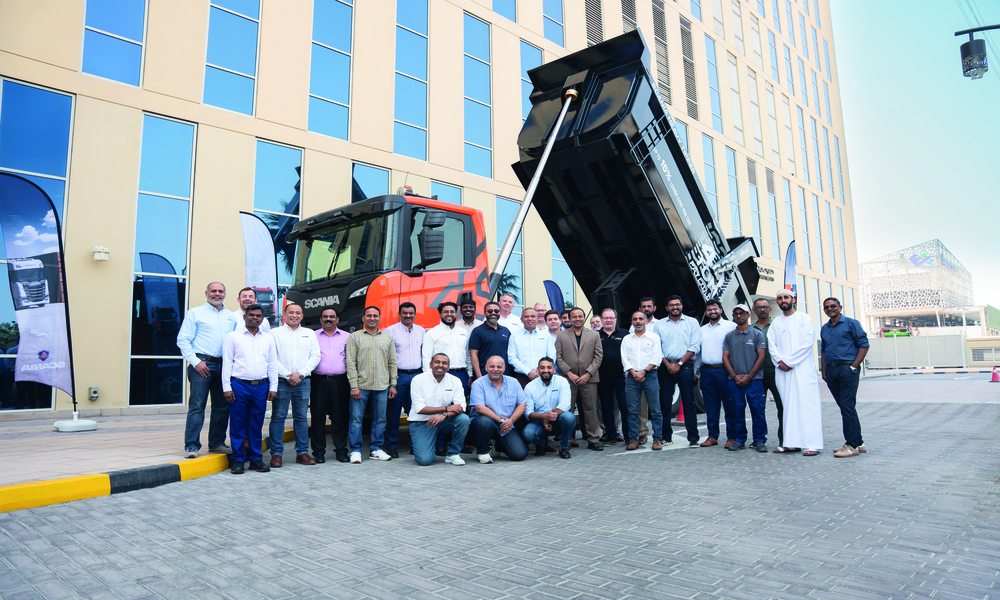
“We already have projects in both the UAE and Saudi Arabia where Scania tippers are being used instead of yellow machines,” he reveals.
Among the strongest examples is Fujairah, one of the UAE’s most significant quarrying centres.
“We recently supplied a batch of trucks to quarries in Fujairah,” he says. “In fact, we already have many Scania units working there across various quarry operations.”
As mining activity accelerates across the Gulf, transport requirements will continue to evolve alongside customer expectations. Operators are demanding equipment that not only carries heavier loads but also delivers greater fuel efficiency, lower emissions, improved uptime and reduced operating costs throughout its working life.
For Piccirillo, these changing priorities align closely with Scania’s long standing engineering philosophy. By combining modular vehicle design, efficient powertrains, local partnerships and a focus on productivity, the company aims to position its 8×4 Super tipper as more than simply another heavy truck. Instead, it represents a transport solution designed to help mining and quarry operators move more material, more efficiently and more sustainably, while delivering the long term economic value increasingly sought by fleets across the Middle East’s rapidly expanding extractive industries.

