


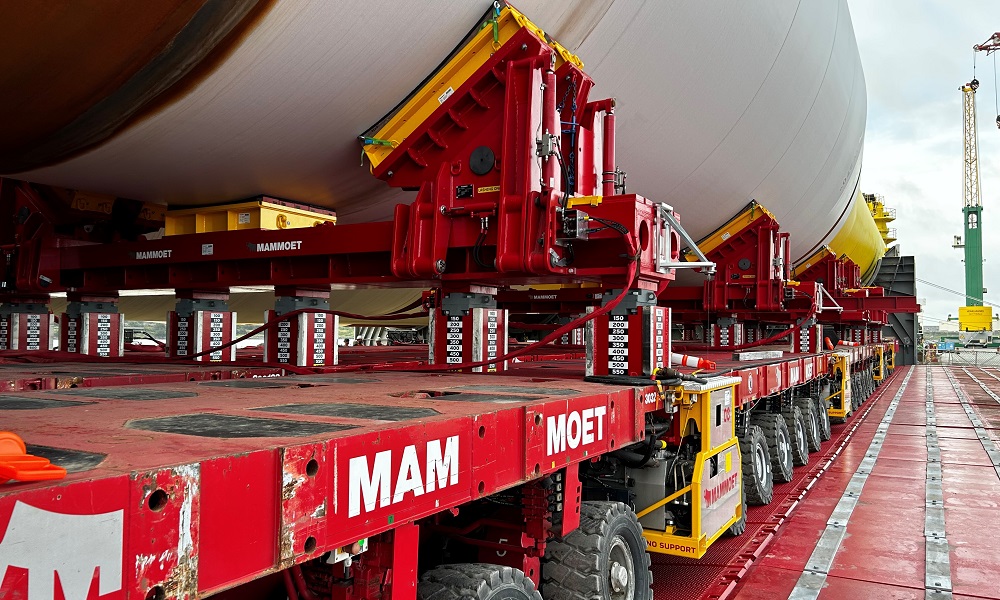
As offshore wind turbines continue to increase in size, the foundations supporting them are also growing, posing challenges for transport and storage. Mammoet has introduced a new jacking and cradle system aimed at mitigating these challenges, ultimately helping customers cut costs.
These colossal cylindrical steel foundations, known as monopiles, play a crucial role in connecting wind turbines to the seabed. With weights exceeding 3,000 tonnes and lengths surpassing 120 meters, their dimensions are steadily expanding.
As wind turbine developers construct taller structures, the diameter and length of their foundations are also on the rise, surpassing the capabilities of existing handling equipment. This trend makes both the transportation to the installation site and on-site storage of these massive monopiles more complex.
Moreover, lifting an extra-large (XXL) monopile results in significant deformations due to its self-weight. Consequently, monopiles must be lifted higher than their supports during the loading and unloading process.
Mammoet’s innovative jacking and cradle system provides an additional 60cm of stroke compared to standard Self-Propelled Modular Transporter (SPMT) systems. This extension allows customers to continue using their existing support structures as monopiles continue to grow in size.
Furthermore, this technology offers benefits throughout the supply chain, helping reduce overall project costs.
With offshore wind projects becoming increasingly globalized, monopiles are traveling longer distances. This necessitates larger sea fastenings on Heavy Transport Vessels to secure monopiles during transit. Consequently, there is less clearance when using SPMTs for loading and unloading large monopiles.
Mammoet’s jacking and cradle system addresses this challenge by enabling monopiles to be lifted higher, accommodating more sea transports using existing support structures.
The system consists of two components: jacking spacers placed between SPMT modules to increase stroke and hydraulic, foldable saddles that cradle the monopile, supporting it at higher points to prevent excessive ovalization.
Each jacking spacer has a capacity of 430 tonnes, distributed across two towers, with multiple units used per transport configuration. Importantly, this system fits between SPMT modules, maintaining the same minimum ride height for transport configurations. This feature allows grillages and sand bunds to remain as low as possible, resulting in cost savings.
Additionally, each monopile saddle can handle up to 1,000 tonnes and monopiles with diameters of up to 12 meters. By adopting this system, Mammoet’s customers can maintain their existing methods of supporting and transporting monopiles, even as they increase in diameter from 8 meters to 10 meters and beyond. This approach effectively reduces costs across the entire project, from fabrication to shipping and storage supply chains.

